· Olivier Demichel · 5 min read
Amstel Gold Race 2025: How Aerodynamics Helped Evenepoel Catch Pogačar
During the 2025 edition of the Amstel Gold Race, Remco Evenepoel caught Tadej Pogačar after he had built a 40-second gap in a solo breakaway. Beyond raw power, the flawless execution of an aerodynamic position likely played a decisive role. Here is our analysis.
Introduction
Amstel Gold Race 2025. Pogačar attacks with 40 km to go. He builds a 40-second lead. The race seems over. On the broadcast, commentators suggest the gap is decisive.
Then Remco Evenepoel launches his pursuit with 26 km remaining.
18 km later, the gap is closed. At nearly 43 km/h average speed, it is an extraordinary performance that even commentators struggle to explain live. How is this possible?
Could Pogačar have been caught through power alone?
To close a 40-second gap over 18 km at an average speed of 43 km/h, Evenepoel needed to ride approximately 1.2 km/h faster than Pogačar. Producing this differential through power alone would require 30 to 40 additional watts over 25 minutes — an unlikely scenario against the best rider in the world.
At these speeds, a 40 seconds gain over 18 km corresponds to roughly a 1.2 km/h speed differential. To create that gap purely through power, one rider would need to produce approximately 30 to 40 additional watts for around 25 minutes.
Against Pogačar in 2025? Unlikely.
Especially considering that throughout the season, Evenepoel has not shown clear superiority over Pogačar on climbs. Even in the second time trial of the Tour de France, Remco lost time to Pogačar on rolling terrain.
Another lever must therefore be considered.
How does aerodynamics explain Evenepoel’s comeback?
CdA (Drag Coefficient × Frontal Area): the key metric for a cyclist’s aerodynamic resistance, measured in m². A 5% CdA reduction translates to roughly 1.5% more speed at constant power.
A 10% reduction in frontal area yields approximately 1 km/h more speed at 43 km/h, translating to 2 to 3 seconds gained per kilometer. Over 18 km, this accounts for exactly the 40-second gap Evenepoel erased. Aerodynamic positioning is the most consistent explanation for this performance.
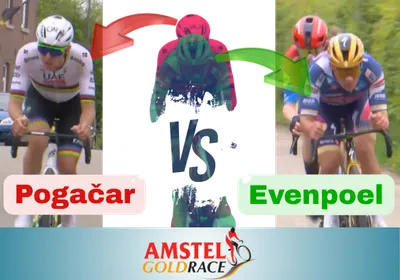
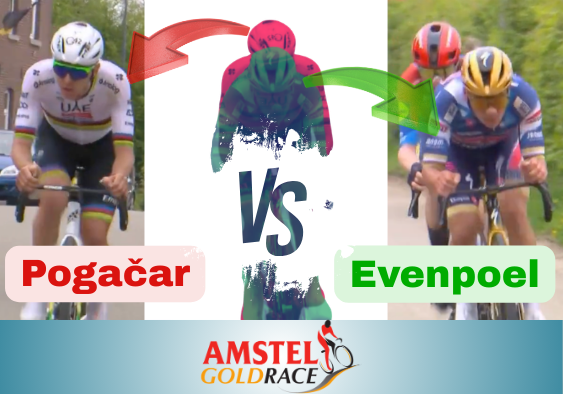
When observing the pursuit and comparing the positions adopted by Tadej and Remco, a key difference stands out.

Evenepoel adopts an extremely compact position:
- Lowered torso
- Elbows tucked in
- Head down
- Forearms nearly horizontal
Pogačar, on the other hand, remains slightly more upright.
Visually, the difference in frontal surface area is clear: nearly 10% more compact for Remco.
Physical translation
Aerodynamic drag represents more than 90% of total power output at these speeds. Reducing frontal area lowers drag and therefore allows higher speed at the same power.
In practice, a 10% variation in frontal area is enough to generate more than 1 km/h difference at these speeds: Tadej rides at 43 km/h, Remco at 44.2 km/h. On each kilometer, Remco gains 2 to 3 seconds. Over 18 km, the 40 seconds are erased.
A more aerodynamic position alone can therefore be sufficient to explain the gap.
What does this really mean?
This does not mean that power does not matter. It remains fundamental. But performance is measured in speed, not watts. And in this race, Remco optimized his speed thanks to flawless mastery of his aerodynamic position.
👉 Aerodynamics amplifies or penalizes every watt produced.
What does this race teach us about cycling performance?
The 2025 Amstel Gold Race demonstrates that cycling performance rests on three inseparable pillars: optimizing aerodynamic position, maintaining it under fatigue, and producing power effectively in that position. This framework is accessible to all cyclists, not just professionals.
The laws of physics are identical for everyone. To perform, you must understand and master them. Remco Evenepoel showed that adopting an optimal position is an ultimate performance lever. It is a free lever to ride faster. Immediately accessible. But what must be understood is that this aerodynamic performance results from three key factors that Remco Evenepoel has built and optimized:
- Optimizing his aerodynamic position
- Holding that position
- Being powerful in that position For this, consistent training is essential, and every cyclist should train in these directions.
Conclusion
The 2025 Amstel Gold Race illustrates a simple reality: At comparable physiological levels, aerodynamic mastery can reverse the outcome of a race.
Aerodynamics does not replace power. It enhances it.
And sometimes, it is enough to catch Pogačar.
Frequently Asked Questions
How did Evenepoel catch Pogačar at the 2025 Amstel Gold Race?
How much difference does aero position make at high speed?
Is aero position more important than power?
How do you train your aero position like the pros?
Read more:

Founder & Engineer
Former CNRS researcher and passionate triathlete, Olivier built AeroX to solve his own aero roadblocks. He now brings scientific rigor and athlete insight to riders — amateur to elite — who want to go faster.